
Refresher course for operating units with Modbus
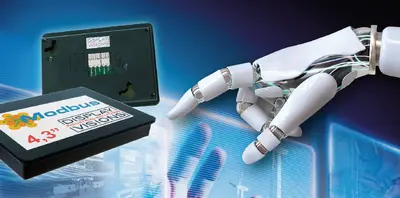
HMI operating units with Modbus RTU/TCP: Brilliant solutions for modern applications - customised and cost-effectively tailored to the process and the requirements of the operator.

The Modbus

... was defined by Modicon in 1979 and is still extremely widespread in industrial control systems today. Almost all PLC controllers support the Modbus protocol via RS-485 or Ethernet. There are also thousands of sensors and actuators available on the market that can be connected directly to a PLC via Modbus. This fieldbus is written down in the IEC 61158 standard(Digital data communication for measurement and control).

In the Modbus protocol, which transmits the data packets secured by a checksum, there are basically 3 different data types: Coil or Discrete Input (1 bit), Input Register or Holding Register (16 bit), and Real or Float (32 bit).

Data is transmitted via a 2-wire or 3-wire interface (RS-485) for Modbus RTU and via LAN/Ethernet or wirelessly via WiFi for Modbus TCP. The operating units are integrated into the system as servers or slaves - the controllers in the system (Siemens, Beckhoff, Rockwell, Panasonic, Wago etc.) are "clients" or "masters"...

Download the complete article (pdf)

FAQ - Questions and Answers About Modbus HMI Control Units

Questions and brief, easy-to-understand answers about Modbus HMI control units

What are the advantages of HMI control units with Modbus RTU/TCP?

HMI control units with Modbus RTU/TCP offer a flexible and cost-effective solution for controlling and monitoring industrial processes. They are customizable and can be seamlessly integrated into existing systems. By supporting Modbus, a widely used protocol, they can communicate with a wide range of PLCs and sensors. Data transmission is secured by checksums, which increases reliability. Additionally, they allow for easy expansion and adaptation to the operator’s specific requirements.

How does data transmission work with Modbus RTU and Modbus TCP?

Data transmission in Modbus RTU takes place via a 2- or 3-wire interface, typically RS-485, which enables robust and interference-free communication. With Modbus TCP, on the other hand, transmission takes place via LAN/Ethernet or wirelessly via Wi-Fi, offering greater flexibility and range. Both variants use the Modbus protocol, which secures data packets using checksums. This guarantees high reliability and integrity of the transmitted data. The choice between RTU and TCP depends on the specific requirements and the existing infrastructure.

What data types are supported by the Modbus protocol?

The Modbus protocol supports three basic data types: Coil or Discrete Input, Input Register or Holding Register, and Real or Float. Coils or Discrete Inputs are 1-bit data typically used for binary switch states. Input and Holding Registers are 16-bit data used for numerical values. Real or Float are 32-bit data used for floating-point numbers, which enables precise representation of measured values. This variety of data types allows for flexible adaptation to different requirements.

What role do HMI control units play in a Modbus system?

In a Modbus system, HMI control units function as servers or slaves, while controllers such as Siemens, Beckhoff, or Rockwell act as clients or masters. The HMI control units receive commands and send data to the controller, enabling efficient process monitoring and control. They are crucial for interaction between the operator and the machine, as they provide a user-friendly interface. Through Modbus integration, they can communicate with a wide range of devices and sensors, which increases the system’s flexibility and scalability.

Why is the Modbus protocol so widely used in industry?

The Modbus protocol is widely used in industry because it provides a simple and effective method for communication between different devices. It was defined in 1979 by Modicon and is now integrated into nearly all PLCs. Support from a wide range of manufacturers and compatibility with various interfaces such as RS-485 and Ethernet make it a versatile solution. Furthermore, it is specified in the IEC 61158 standard, which underscores its reliability and standardization. These characteristics make Modbus a preferred protocol for industrial applications.

Why is DISPLAY VISIONS the best choice for HMI control units with Modbus?

DISPLAY VISIONS is the best choice for HMI control units with Modbus, as the company has extensive experience and expertise in the development of industrial displays and control solutions. They offer customized solutions that are precisely tailored to their customers' needs. DISPLAY VISIONS products are known for their high quality, reliability, and durability. In addition, the company offers comprehensive service and consulting to ensure that customers receive the best possible solution for their specific applications. This combination of quality, adaptability, and customer service makes DISPLAY VISIONS the ideal choice for HMI control units with Modbus.
Deutsch
Französisch